


быстрая доставка ~4 недели
Размер
- 100 μL
- 200 μL
- 50 μL
FMO3 Rabbit mAb (A19222)
- Описание
- Характеристики
-
Overview
Product name FMO3 Rabbit mAb Catalog No. A19222 Host species Rabbit Purification method Affinity purification Isotype IgG CloneNo. ARC2377 Background
Flavin-containing monooxygenases (FMO) are an important class of drug-metabolizing enzymes that catalyze the NADPH-dependent oxygenation of various nitrogen-, sulfur-, and phosphorous-containing xenobiotics such as therapeutic drugs, dietary compounds, pesticides, and other foreign compounds. The human FMO gene family is composed of 5 genes and multiple pseudogenes. FMO members have distinct developmental- and tissue-specific expression patterns. The expression of this FMO3 gene, the major FMO expressed in adult liver, can vary up to 20-fold between individuals. This inter-individual variation in FMO3 expression levels is likely to have significant effects on the rate at which xenobiotics are metabolised and, therefore, is of considerable interest to the pharmaceutical industry. This transmembrane protein localizes to the endoplasmic reticulum of many tissues. Alternative splicing of this gene results in multiple transcript variants encoding different isoforms. Mutations in this gene cause the disorder trimethylaminuria (TMAu) which is characterized by the accumulation and excretion of unmetabolized trimethylamine and a distinctive body odor. In healthy individuals, trimethylamine is primarily converted to the non odorous trimethylamine N-oxide.Immunogen information
Immunogen A synthetic peptide corresponding to a sequence within amino acids 300-400 of human FMO3 (P31513). Sequence KPNVKEFTETSAIFEDGTIFEGIDCVIFATGYSFAYPFLDESIIKSRNNEIILFKGVFPPLLEKSTIAVIGFVQSLGAAIPTVDLQSRWAAQVIKGTCTLP Gene ID Swiss Prot Synonyms TMAU; FMOII; dJ127D3.1 Calculated MW 60kDa Observed MW 58kDa Applications
Reactivity Human, Mouse, Rat Tested applications WB IF/ICC Recommended dilution - WB 1:500 - 1:1000
- IF/ICC 1:50 - 1:200
Storage buffer Store at -20℃. Avoid freeze / thaw cycles.
Buffer: PBS with 0.02% sodium azide, 0.05% BSA, 50% glycerol, pH7.3.Key application Western blotting Immunofluorescence Positive samples Mouse lung, Mouse liver, Mouse kidney, Rat liver, Rat kidney Cellular location Endoplasmic reticulum membrane, Microsome membrane 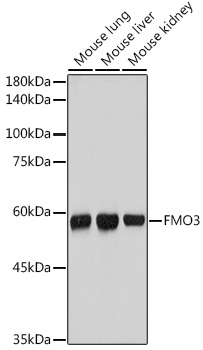
Western blot analysis of extracts of various cell lines, using FMO3 antibody (A19222) at 1:1000 dilution.
Secondary antibody: HRP Goat Anti-Rabbit IgG (H+L) (AS014) at 1:10000 dilution.
Lysates/proteins: 25μg per lane.
Blocking buffer: 3% nonfat dry milk in TBST.
Detection: ECL Basic Kit (RM00020).
Exposure time: 1s.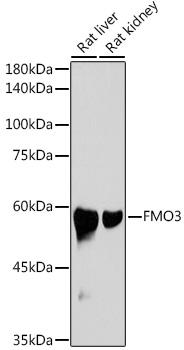
Western blot analysis of extracts of various cell lines, using FMO3 antibody (A19222) at 1:1000 dilution.
Secondary antibody: HRP Goat Anti-Rabbit IgG (H+L) (AS014) at 1:10000 dilution.
Lysates/proteins: 25μg per lane.
Blocking buffer: 3% nonfat dry milk in TBST.
Detection: ECL Basic Kit (RM00020).
Exposure time: 5s.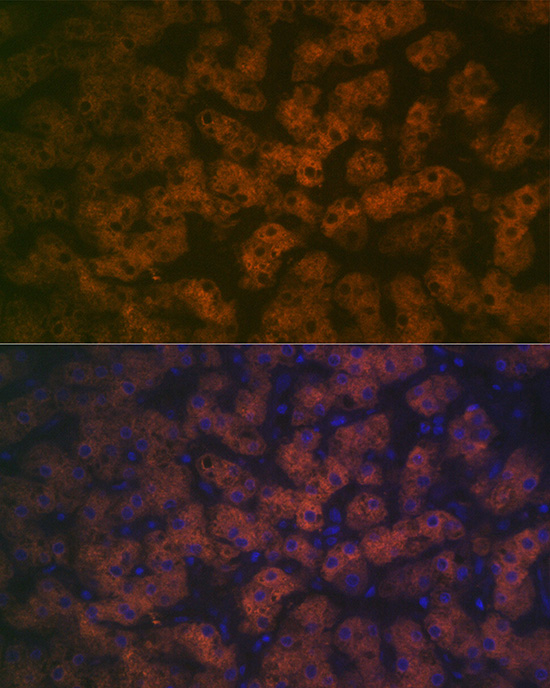
Immunofluorescence analysis of Human liver cells using FMO3 antibody (A19222) at dilution of 1:100. Blue: DAPI for nuclear staining.
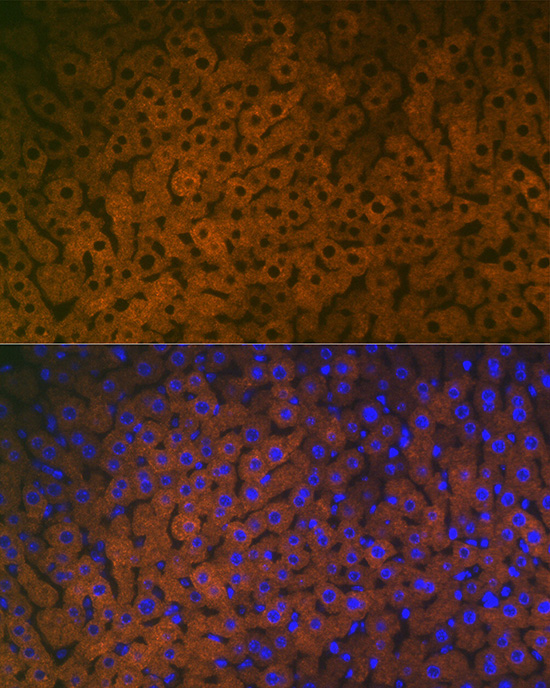
Immunofluorescence analysis of Mouse liver cells using FMO3 antibody (A19222) at dilution of 1:100. Blue: DAPI for nuclear staining.
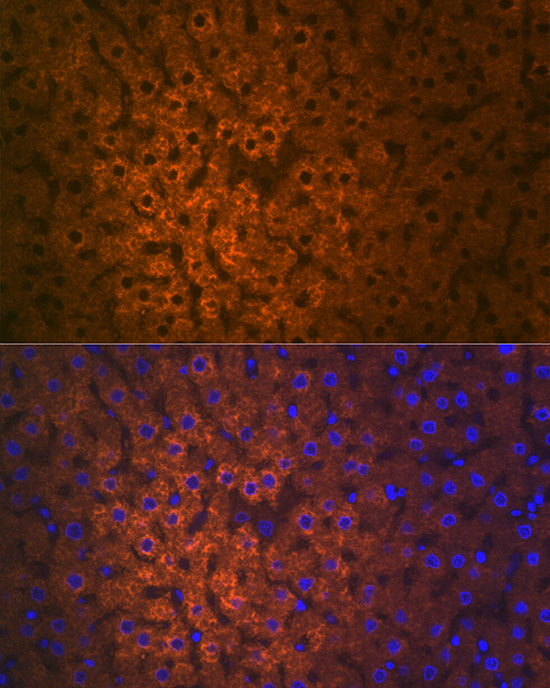
Immunofluorescence analysis of Rat liver cells using FMO3 antibody (A19222) at dilution of 1:100. Blue: DAPI for nuclear staining.
-
Key applications Western blotting, Immunofluorescence Host species Кролик Antibody type Primary Antibodies Reactivity Человек, Мышь, Крыса Immunogen A synthetic peptide corresponding to a sequence within amino acids 300-400 of human FMO3 (P31513). Isotype IgG